

What is concrete bleeding?
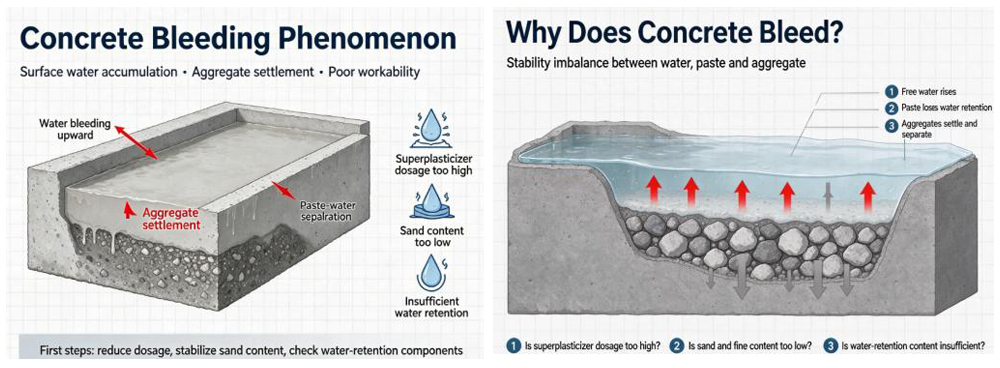
1. After fresh concrete is placed and vibrated, and before initial set, coarse aggregates and cement particles settle under gravity, while free water migrates upward and accumulates on the surface to form standing water or a water film. This phenomenon is bleeding. A small amount of bleeding is normal, but excessive bleeding is a defect:
- • 2. The surface laitance layer becomes porous and low in strength, resulting in later dusting, sanding and poor wear resistance.
- • 3. Water pockets form beneath reinforcing bars and aggregates, reducing the bond strength and creating capillary channels, which impair water resistance and durability.
- • 4. Bleeding is often accompanied by segregation, stratification and delayed bleeding (massive water exudation occurring some time after vibration).
- • 5. Simple distinction: Bleeding refers to upward migration of free water; segregation means separation of coarse aggregate from mortar. The two frequently occur together.
On-site Remedial Actions (for bleeding fresh concrete after placement)
⚠️ Critical notes: It is strictly prohibited to mix bleed water back into the concrete. Unauthorized addition of water at the jobsite is forbidden.
1. Slight bleeding: (only a thin water film, no standing water): Allow natural evaporation under static conditions. Perform the second finishing (trowelling) when most bleed water has evaporated and the concrete reaches a suitable plastic state to reduce surface cracking and dusting.
2. Obvious ponding / water puddles: Remove bleed water using sponges, geotextile or rubber squeegees. Drain only clear water without removing mortar. Do not create drainage channels (this will wash out cement paste and cause immediate segregation).
3. Vibration control: Insert vibrators quickly and withdraw slowly. Stop vibrating once concrete stops subsiding, no excessive air bubbles rise, and mortar appears on the surface. Avoid over-vibration (over-vibration is one of the most common on-site causes of bleeding). Place concrete in layers, with each layer thickness controlled at 30–40 cm. Do not pour in a single thick lift.
4. Delayed bleeding: (concrete appears normal on arrival, but water seeps out gradually after vibration): Notify the batching plant immediately and stop discharging. Take samples and test slump before resuming casting. Do not continue pouring. This issue is mostly caused by overdosed slump-retaining / retarding components in admixtures or incompatibility between admixture and cement.
3. For slabs and wear-resistant flooring
Do not spread hardener before bleed water is fully removed. After ponding water is removed, carry out wear-resistant construction in accordance with the specified procedure.
Measures to mitigate bleeding
Based on the mechanism of concrete bleeding and various influencing factors, measures to reduce concrete bleeding are listed below:
Quick Reference Checklist for Rapid Judgment
- ✓ 1. Sufficient cementitious materials, higher sand ratio, low water content and air entrainment stabilize the paste;
- ✓ 2. Proper fine powders and high-quality admixtures – reliable raw materials reduce bleeding;
- ✓ 3. Proper water reduction, no over-dosing, controlled dosage prevents bleeding;
- ✓ 4. Gentle vibration without over-vibration, standardized construction avoids segregation and bleeding.
Contact:
FAR EAST YU LA INDUSTRY LIMITED
Address: B 406, Woli City, No 2419 Hunan Rd, Pudong Dis, Shanghai, China-201204
Tel: +86-21-68060380
E-mail: sales@yladmixture.com
Website: https://www.yladmixture.com/
Post time: 11-27-2026